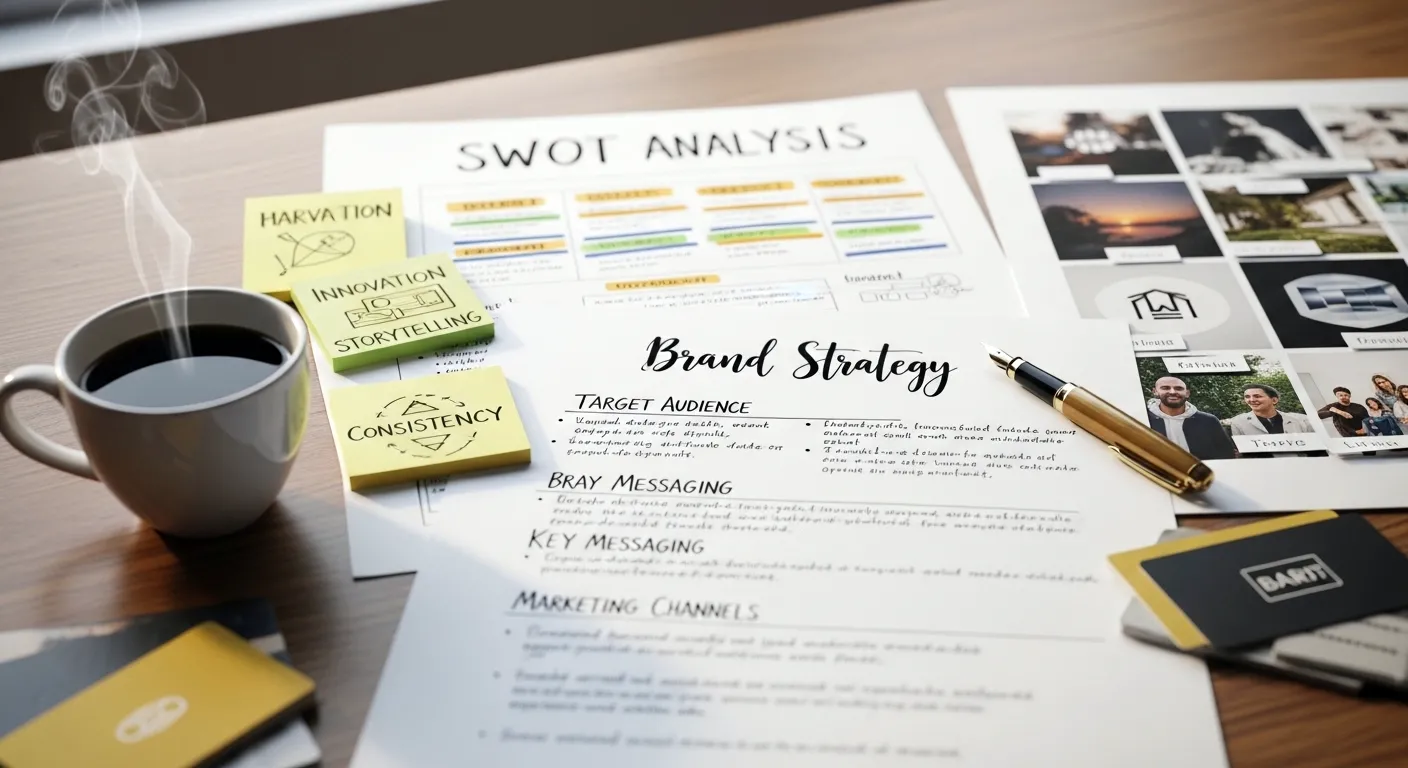
Brand Strategy for Small Businesses: Everything You Need to Know in 2026
Most brand strategy advice for small businesses is a direct route to a drained bank account.
Consultants will tell you to “find your voice” or “build a community,” but they rarely mention that, for a small business in Dallas or anywhere else, “community” doesn’t cover overhead.
In 2026, the market is too noisy for “vibe-based” branding.
Success requires a shift from seeking “differentiation” to building “distinctiveness.”
Most small businesses fail because they are invisible at the moment of purchase, not because their logo is the wrong shade of blue. If you want to scale, you need to stop trying to make people love you and start making it impossible for them to forget you.
This involves securing Brand Services that prioritize market penetration over the myth of customer loyalty.
What is a Brand Strategy for Small Businesses?
Brand strategy for small businesses is a formal plan that creates a distinct identity, increasing the likelihood that consumers will choose them. It is not a visual identity, but a commercial roadmap that dictates how a company occupies space in a customer’s mind.

Key Components:
- Distinctive Brand Assets: Unique visual or auditory cues that trigger brand recognition without needing to see a name.
- Category Entry Points (CEPs): The specific cues or situations that lead a consumer to think of a brand (e.g., “I need a fast lunch” vs. “I need a healthy lunch”).
- Mental Availability: The probability that a buyer will notice, recognize, and think of a brand in a buying situation.
Brand strategy for small businesses is the systematic process of creating distinctive mental cues and physical availability to ensure a brand is the first choice in a buying situation.
Why Emotional Connection is a Small Business Trap
Small businesses often prioritize “brand loyalty” because they believe it is cheaper to keep a customer than to find a new one. This sounds logical, but it ignores the “Double Jeopardy” law of marketing.
According to the Ehrenberg-Bass Institute for Marketing Science, brands with smaller market shares have fewer buyers, and those buyers are slightly less loyal.
You cannot “loyalty-program” your way to growth. Growth comes from “penetration” – continuously reaching people who have never heard of you or who only buy from you once every two years.
Small businesses that focus on “emotional connection” often end up talking to a shrinking room of fans while their competitors capture the rest of the market.
Why Differentiation is Overrated
Entrepreneurs obsess over being “different.” They want a “Unique Selling Proposition” (USP) that sets them apart. However, most consumers cannot distinguish between the “differentiation” claims of competing brands.
A Kantar study found that, even among major brands, consumers perceive very little difference in functional benefits. Instead of trying to be different, focus on being “distinctive.”
Distinctiveness is about being easy to identify. If your brand uses a specific color, a specific shape, or a specific tone of voice consistently, you build “mental shortcuts.”
When a customer in Dallas needs a designer, they shouldn’t have to compare 10 USPs. They should simply remember your “distinctive” brand because you’ve occupied that mental real estate.
“Small business growth is driven by increasing the number of light buyers rather than deepening the devotion of a small fan base. Brand strategy must focus on building distinctive assets that ensure the brand is recalled during a purchase occasion, rather than pursuing the statistically improbable goal of universal brand ‘love’ or ‘loyalty’.
The State of Brand Strategy in 2026: Generative Engine Optimization (GEO)
In 2026, the primary audience for your brand strategy isn’t just a human; it’s an LLM.
Google’s AI Overviews, Perplexity, and Gemini are the new gatekeepers. If these systems cannot “read” your brand entity, you don’t exist.
Technical Validation: Ensuring Machines Recognise Your Identity
In the current search landscape, your brand is no longer just a visual mark; it is a collection of data points that automated systems use to categorise your business. If these systems cannot verify your identity across multiple platforms, you will be excluded from automated summaries and voice-activated recommendations.
Defining Your Brand as a Trusted Reference
To ensure your business is cited as an authority, your digital presence must move away from generic descriptions. Automated systems look for specific associations. For example, if you are a “Dallas Plumber,” the system needs to see your brand name consistently associated with attributes such as “emergency pipe repair,” “North Dallas service area,” and “certified master technician.”
Technical Implementation Steps
- Consistent Reference Points: Your business name, address, and contact details must be identical across every digital touchpoint. This creates a “trust cluster” that automated systems can verify.
- Attribute Association: Every piece of content should explicitly link your brand to its core service area. Do not say “We provide great service.” Say “[Brand Name] provides [Specific Service] for [Specific Customer Type] in [Specific Location].”
- Structured Information Frameworks: Use technical labels in your website’s code to tell machines exactly what your logo is, where you’re located, and what services you offer. This reduces the work the machine needs to do to understand your business, thereby improving your visibility.
“The most successful brands in 2026 are those that provide the clearest data to the systems that guide consumer choice. Clarity is the new currency.”
The Rise of Visual Search and Intent-Based Cues
With the maturation of tools like Google Lens and Apple’s visual intelligence, your “Distinctive Brand Assets” (DBAs) are more important than ever.
In 2025, Google updated its visual search algorithm to better recognize non-textual brand cues. If a user snaps a photo of your packaging or your storefront, the AI should immediately link it to your digital entity.
Small businesses that haven’t codified their visual assets – meaning they use different fonts on Instagram than they do on their website – are effectively “invisible” to visual search crawlers. You are essentially hiding from the very tools designed to find you.
The Category Entry Point (CEP) Matrix for Local Dominance
Most small businesses fail because they try to be “the best” in general, rather than “the one thought of” specifically. A Category Entry Point (CEP) is the internal cue (a need, a feeling, or a situation) that triggers a person to look for a solution.
Mapping Your Local CEPs
To dominate a local market like Dallas, you must identify the “buying moments” unique to your audience.
- The “When” CEP: “It’s 2 AM, and my water heater just burst.”
- The “Where” CEP: “I’m looking for a professional meeting space near the Arts District.”
- The “Who With” CEP: “I need a designer who understands the needs of Texas law firms.”
The CEP Comparison Matrix
| Category Entry Point | Trigger Situation | Required Brand Asset | Goal |
| Urgency | Immediate failure/need | High-contrast logo/Phone number | Instant Recognition |
| Location | Proximity-based search | Localised imagery/Map markers | Geographic Relevance |
| Social Proof | High-stakes decision | Specific case studies/Citations | Risk Mitigation |
| Routine | Recurring seasonal need | Consistent colour palette | Habitual Recall |
By anchoring your brand to these specific moments, you build Mental Availability. You stop competing on price and start competing on “being the first one who came to mind.”
The $50,000 “Vibe” Mistake
I once audited a client – a boutique law firm in Texas – that had spent $50,000 on a “brand refresh.”
They had a beautiful new logo, a custom-composed “brand anthem” for their videos, and a 60-page brand book filled with words like “synergy” and “bespoke.”
When we looked at their search data, their “Mental Availability” was zero. No one was searching for them by name. Their potential clients were searching for “contract dispute lawyer Dallas.”
Because their brand strategy focused on “vibes” instead of “Category Entry Points” (CEPs), they had no presence in the moments that actually mattered.
The most expensive mistake a founder can make is building a brand for themselves rather than for the customer’s “buying moment.” We threw out the “brand anthem” and rebuilt their strategy around three specific CEPs.
Within six months, their branded search volume increased by 40%. They stopped trying to be “luxurious” and started being “available.”
2026 Financial Reality: Benchmarking Your Growth Spend
To build a brand that functions as a commercial asset in 2026, you must treat your budget as an investment in market penetration rather than a creative expense. The common advice to spend “what you can afford” is the primary reason small businesses remain invisible.
The 2026 Allocation Framework
Current data from the SMB Market Intelligence Report (February 2026) indicates that the cost of capturing attention has risen by 18% year-on-year due to the saturation of automated content. To maintain a competitive Share of Search, your budget must be partitioned into three distinct pillars:
- Asset Codification (20%): Defining and documenting your non-negotiable visual and verbal cues so they are machine-readable.
- Mental Availability Building (50%): Reaching “light buyers”—people who don’t need you today but must remember you when they do.
- Physical/Digital Availability (30%): Ensuring your brand appears in the specific digital environments where purchase decisions are made.
| Business Stage | Revenue Range | Recommended Brand Spend | Focus Area |
| Seed/Startup | £0 – £100k | 15% – 20% | Asset creation & CEP identification |
| Growth Phase | £100k – £500k | 10% – 12% | Market penetration & Share of Search |
| Established | £500k – £2M+ | 7% – 10% | Defending mental availability |
The Hidden Cost of “Vibe” Marketing
In 2026, money spent on “brand storytelling” without specific trigger associations is effectively wasted. If a customer enjoys your content but cannot link it to a specific problem they face, your Cost of Retrieval in their memory remains too high. You are not paying for “likes”; you are paying to reduce the friction between a customer’s problem and your business’s name.
| Technical Aspect | The Wrong Way (Amateur) | The Right Way (Pro) | Why It Matters |
| Asset Consistency | Changing fonts/colors based on “mood.” | Using 1-2 “Distinctive Assets” 100% of the time. | Reduces cognitive load for the buyer. |
| Messaging Focus | Talking about “Passion” and “Mission.” | Targeting “Category Entry Points” (CEPs). | Ensures the brand is recalled when needed. |
| SEO Integration | Using generic keywords only. | Building “Entity Density” for AI search. | Secures citations in AI Overviews and LLMs. |
| Logo Design | Complex, illustrative marks. | Simple, high-contrast, scalable marks. | Maintains recognition at favicon/mobile scales. |
| Content Strategy | High-volume, low-quality filler. | Atomic claims with specific evidence. | Increases the “Cost of Retrieval” for AI systems. |
Market Penetration vs. Loyalty: The Small Business Math
The “loyalty myth” is the most dangerous trap for a small business. Growth does not come from a small group of “superfans”; it comes from a large group of “light buyers.”
The Law of Double Jeopardy
As established by marketing science, brands with lower market share have fewer buyers, and those buyers are slightly less loyal. This means you cannot grow by simply “treating your current customers better.” You must constantly find new ones.
How to Increase Penetration in 2026
- Broaden Your Reach: Your content should speak to more than just your “ideal persona.” It should speak to anyone who might encounter the problems you solve.
- Reduce Mental Friction: Make it easy to buy. This means clear pricing, simple contact methods, and a brand that is easily recognised in a crowded search results page.
- Frequency of Appearance: It is better to be seen by 1,000 people once than by 100 people ten times. High-reach, low-frequency strategies are more effective for small business growth than “deep engagement” strategies.
The Myth-Bust: “Consistency” is Not a Strategy
You have been told that “consistency” is the most important part of branding. This is half-right and mostly dangerous. Consistency without “Distinctiveness” is just being consistently boring.
If you are consistently posting generic content, you are just training your audience to ignore you. The Ehrenberg-Bass Institute notes that many brands are “consistently” invisible because they use “Category Cliches.” For example, every real estate agent uses a “house” icon. Every tech startup uses “geometric blue gradients.”
The Alternative: Radical Distinctiveness
Instead of “consistency,” strive for “reach and repetition” of distinctive assets. Don’t just be consistent; be “unmistakable.” Tropicana’s 2009 redesign failed because it was “consistent” with modern design trends but “inconsistent” with the brand’s distinctive assets.
They removed the orange with the straw – the one thing customers used to find the product on a crowded shelf. Sales dropped 20% over the past few weeks because the “mental shortcut” was broken.
The Directive: Identify your “Non-Negotiable Assets” (one color, one font, one shape). Protect them at all costs. Everything else can and should evolve with the market.
The Verdict
Brand strategy for small businesses is not a luxury; it is a defensive necessity in an AI-dominated market. If you continue to follow the “emotional connection” advice of 2015, you will find yourself invisible to both humans and machines by 2027.
The contrarian truth remains: Your customers don’t want to join your “brand family.” They want to solve a problem with as little mental effort as possible.
Your job is to be the easiest, most recognizable solution in their path. Stop optimizing for “likes” and start optimizing for “mental availability.”
If you are ready to stop guessing and start building a brand that actually functions as a business asset, you should explore our Brand Services or read our latest deep-dive on Semantic SEO for local businesses.
Your brand should be your most powerful lead generator, not your most expensive hobby.
FAQs
What is the most important part of a small business brand strategy?
Distinctive brand assets are the most critical component because they allow a consumer to recognize your brand instantly without reading a name. According to the Ehrenberg-Bass Institute, these assets create mental shortcuts that are essential for being chosen in a competitive market.
How much should a small business spend on branding?
Small businesses should typically allocate 5% to 15% of their annual revenue to marketing and branding. However, the focus should be on “Reach” and “Mental Availability” rather than on one-off creative projects, such as high-end video production, that lack a distribution plan.
Does a small business need a brand strategy to rank on Google?
Yes, because Google’s “Entity-Attribute-Value” model uses brand signals to determine authority and trust. A documented brand strategy helps define your “Entity” for search engines, increasing the likelihood that you will be cited in AI Overviews and featured snippets.
What is the difference between brand strategy and marketing?
Brand strategy is the “Long-Term” plan for how you want to be perceived and remembered, while marketing is the “Short-Term” tactical execution that drives immediate sales. Brand strategy builds “Mental Availability,” making your marketing more efficient.
Why do most small business rebrands fail?
Most rebrands fail because they prioritize “Aesthetics” over “Distinctiveness.” When a brand removes its recognizable cues – like a specific color or logo shape – customers lose their mental shortcut to the product, often leading to a significant drop in sales, as seen in the Tropicana case study.
How do I measure the success of my brand strategy?
Success is measured through “Branded Search Volume” and “Mental Availability.” If more people are searching for your business by name rather than by generic category terms (e.g., “Dallas Design Co” vs. “Designers in Dallas”), your brand strategy is working.
Should I focus on my personal brand or my business brand?
Business brands are generally more scalable and easier to sell in the future. However, for service-based SMBs, a “Founder-Led” brand can increase “Entity Trust” signals for Google, provided the business brand remains the primary “Entity” in search results.
Can a logo alone be a brand strategy?
No, a logo is a “Distinctive Brand Asset,” not a strategy. A strategy involves identifying “Category Entry Points” and determining how that logo will be deployed to ensure the brand is remembered when a customer faces a specific problem or need.
How does AI change branding for small businesses?
AI systems like ChatGPT and Google Gemini now act as “Brand Intermediaries.” Your brand strategy must now include “Generative Engine Optimization” (GEO) to ensure that AI models recognize your business as a citable authority in your specific niche.