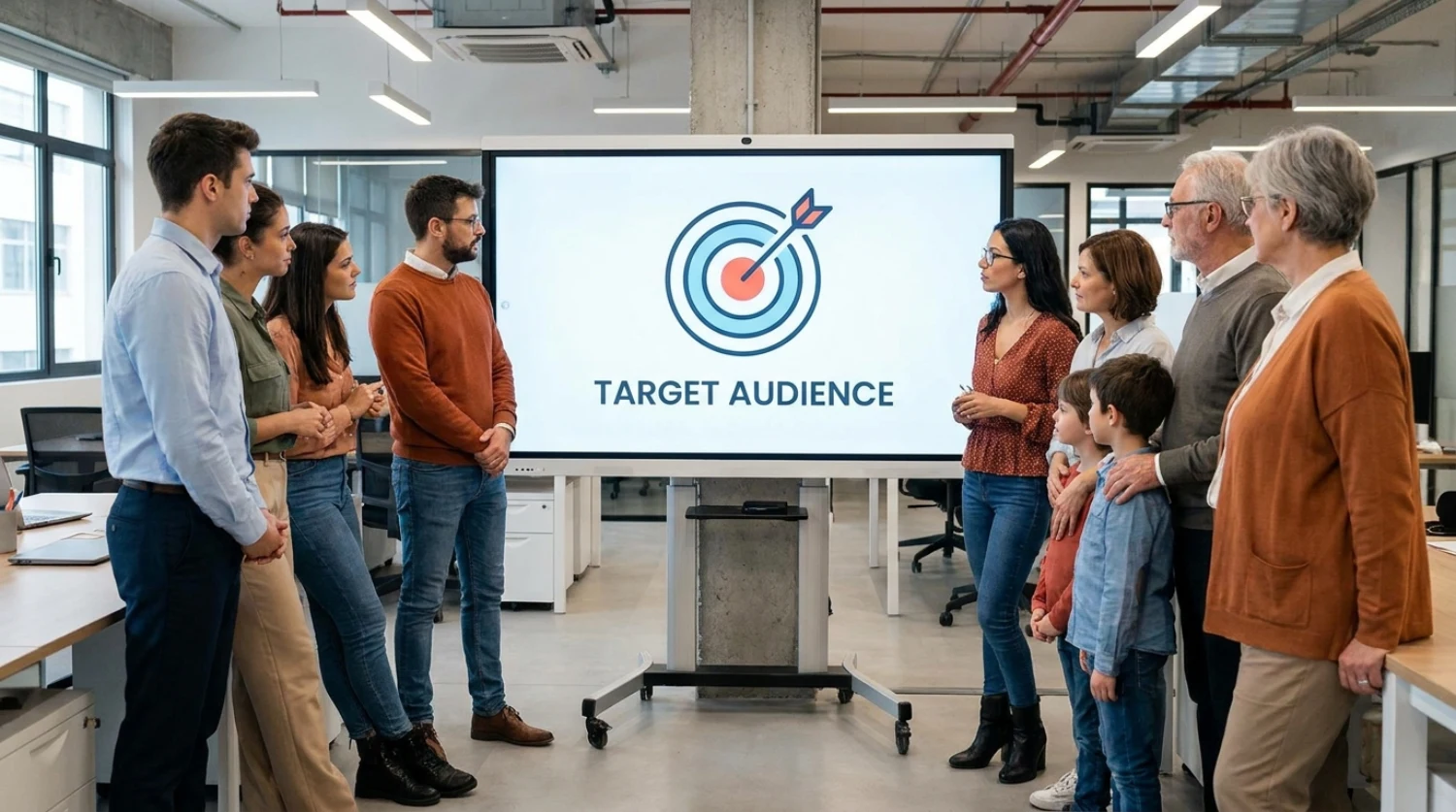
Target Audience vs Ideal Customer Profile: The Key Differences You Need to Know
Most Dallas small business owners are burning roughly 40% of their marketing budget on people who will never write them a check.
This financial leak happens because they treat “Target Audience” as a creative writing exercise rather than a rigid financial filter.
If you are still building “Marketing Mary” personas based on hobbies and hypothetical coffee preferences, you are doing creative fiction, not business strategy.
The reality is that your target audience is anyone who might buy your product, but your Ideal Customer Profile (ICP) is the only group you can afford to serve.
Confusing the two leads to bloated ad spend and low-quality leads. To win in 2026, you must stop chasing “reach” and start chasing “relevance.”
An effective Brand strategy for small businesses requires a clinical distinction between these two entities.
What Are Target Audiences?
A target audience is a broad segment of consumers or businesses that share general characteristics and are identified as potential purchasers of a product or service. It defines the outer boundary of your market reach.

Key Components:
- Demographics: Basic data points including age, gender, location, and income level.
- Psychographics: Shared interests, values, and lifestyle choices that influence buying intent.
- Market Scale: The total addressable market (TAM) that your brand intends to influence through top-of-funnel awareness.
The difference between a target audience and an ideal customer profile is scope: target audiences define “who might buy,” while ICPs define “who must buy” for maximum profitability.
The Strategic Divide: Reach vs. Revenue
A target audience tells you where to point the megaphone; an Ideal Customer Profile (ICP) tells you who to hand the contract to.
In Dallas, where competition for local service visibility is high, failing to distinguish between these leads to a “race to the bottom” on pricing.
The Technical Anatomy of a Target Audience
Target audiences are built for awareness. They include everyone from the person who might buy a gift for a friend to the researcher looking for information.
For example, a Dallas-based landscaping company might target “Homeowners in Highland Park, aged 30–60, with a household income over $150,000.” This is a useful starting point, but it is too broad for high-efficiency digital spend.
According to the Nielsen Norman Group (NN/g), the UX research consultancy, broad targeting leads to a “dilution of value” where messaging becomes so generic that it fails to resonate with high-intent buyers.
When you try to speak to everyone in your target audience, you end up boring the specific people who have the highest “pain-to-solution” fit.
The Financial Precision of an ICP
An ICP is a firmographic and behavioral description of the customer that delivers the highest Lifetime Value (LTV) at the lowest Customer Acquisition Cost (CAC). Using the landscaping example, the ICP isn’t just a “homeowner.”
It is a “Property manager of luxury estates over 2 acres with existing irrigation systems that require monthly maintenance and a minimum annual contract value of $12,000.”
This level of detail allows for brand positioning that speaks directly to a specific operational need. HubSpot, the CRM and inbound marketing software provider, noted in its 2024 State of Marketing Report that businesses focusing on ICP-specific messaging saw a 21% increase in lead quality compared to those using broad audience targeting.
The target audience defines the sandbox your brand plays in, but the Ideal Customer Profile identifies the specific individuals who will pay for the toys. Businesses that fail to separate these entities waste significant capital by marketing to the “curious” rather than the “ready,” leading to inflated cost-per-acquisition metrics that erode profit margins.
The “Marketing Mary” Myth: Why Your Personas Are Failing
Traditional persona building is a relic of the 1990s that has no place in a 2026 marketing stack.
For years, agencies have told founders to name their customers, give them a dog, and decide if they prefer tea or coffee.
This is not a strategy; it is a distraction.
The Empathy Trap
The myth suggests that if you can empathize with “Mary,” you can sell to her. But “Mary” doesn’t buy products because she likes Pilates; she buys them because she has a specific problem that requires a specific solution.
McKinsey & Company’s 2024 Brand Perception Report shows that 71% of consumers expect personalization, but it must be based on utility rather than superficial demographics.
When you focus on fictional hobbies, you ignore the technical constraints of the purchase.
For B2B companies in Dallas, your ICP should focus on technographics—what software is the client already using? What is their internal approval process? How do they measure success? These are the factors that determine if a sale happens, not whether the CEO likes the Dallas Cowboys.
From Fiction to Data-Backed Profiles
Instead of “Marketing Mary,” you need “Segment A: High-Intent Tech Migrators.”
This profile is based on zero-party data—information the customer intentionally shares with you. This shift moves your brand messaging framework from “guessing” to “responding.”
The Ehrenberg-Bass Institute, an international marketing research center, found that brand distinctiveness is built through consistent exposure to specific triggers. If your persona is a fiction, your triggers will be misaligned.
You must replace the “hobbies” section of your persona with “Trigger Events” (e.g., “The client just received a Series B funding round” or “The client’s current contract with a competitor is expiring in 60 days”).
Traditional buyer personas often function as creative roadblocks rather than strategic assets. By focusing on superficial demographics and fictionalized hobbies, brands miss the behavioral triggers and technical constraints that actually drive purchase decisions. In 2026, profit is found in data-validated behavior, not in the imaginary lives of fictionalized archetypes.
The Wrong Way vs The Right Way
| Decision Point | The Wrong Way (Amateur) | The Right Way (Pro) | Why It Matters |
| Data Source | Gut feeling and “imaginary” personas | First-party CRM data and market research | Accuracy prevents wasted ad spend. |
| Focus | Hobbies and lifestyle (Psychographics) | Problems and triggers (Behavioral) | Solving a problem leads to a sale. |
| Goal | Reach and total impressions | Conversion and high LTV | Reach doesn’t pay the payroll. |
| Messaging | Generic “We do everything” slogans | Hyper-specific “Problem-Solution” fits | Specificity builds immediate trust. |
| Location | National/Broad targeting | Hyper-local or segment-specific targeting | Local Dallas context increases relevance. |
The State of Audience Strategy in 2026
In 2026, the biggest shift in audience strategy is the rise of Synthetic Audience Prototyping.
As privacy laws like the CCPA and GDPR continue to evolve, and third-party cookies become a memory, brands are turning to AI-driven models to predict consumer behavior.
AI-Driven Audience Synthesis
Tools like Synthetic Users, an AI-driven research platform, allow Dallas agencies to run “digital focus groups” on an ICP before spending a dollar on creative.
By feeding an LLM the specific firmographic and behavioral data of an ICP, designers can test how a brand message might be received.
This isn’t a replacement for real human interaction, but it acts as a high-speed filter for how to create a brand strategy that doesn’t flop.
The Zero-Party Data Revolution
Consumers are increasingly skeptical of “creepy” tracking. The response in 2026 is a move toward Zero-Party Data. This is data that the customer gives you freely—usually through quizzes, calculators, or interactive content.
For a Dallas SMB, this might mean a “Project Cost Calculator” on your website. This tool doesn’t just generate a lead; it also validates the user’s ICP status by capturing their specific budget and timeline.
Gartner, the technological research and consulting firm, predicts that by the end of 2026, 40% of mid-sized brands will rely primarily on zero-party data to fuel their personalization engines.
If you aren’t building these data-capture mechanisms into your site today, you will be blind to your ICP by tomorrow.
The shift toward AI-driven synthetic prototyping and zero-party data acquisition marks the end of “guesswork” in audience targeting. Brands that leverage these technical tools to validate their Ideal Customer Profile before launch significantly reduce their market-entry risk and increase the precision of their messaging.
The $50k Mistake
I once audited a Dallas-based SaaS startup that was spending $12,000 a month on LinkedIn ads. Their target audience was “Founders and CEOs in Texas.”
On the surface, it looked fine. They were getting clicks, their “Marketing Mary” persona was pinned to the wall, and the creative was “edgy.”
But when we looked at the actual sales data, their conversion rate from lead to customer was less than 1%. Why?
While they were reaching “Founders,” they weren’t reaching the right ones. Their software required a minimum of 50 employees to be useful, but 80% of their ad clicks were coming from solopreneurs and “lifestyle” founders who couldn’t afford the subscription or didn’t need the scale.
The most expensive mistake I’ve watched a founder make is prioritizing “likes” over “checks.” We tightened their targeting to a strict ICP: “CFOs or Operations Directors of Texas-based manufacturing firms with 50-200 employees using legacy ERP systems.”
Ad spend dropped by 50%, but their sales pipeline value tripled in 90 days. If your branding feels like it’s shouting into a void, it’s usually because you’ve built a brand for an audience, not a profile. You can avoid these brand strategy mistakes by being ruthless about who you exclude.
The Verdict
The distinction between a target audience and an Ideal Customer Profile is the difference between a vanity metric and a profit margin.
In 2026, the “Marketing Mary” persona is dead. It has been replaced by data-driven behavioral triggers and firmographic constraints. A target audience is a general direction; an ICP is a destination.
If you are a Dallas SMB owner, stop trying to be everything to everyone. Your goal is to be the only logical choice for a very specific group of people.
This requires a brand that is built on technical precision, not creative guesswork. Use your target audience to understand the market, but use your ICP to build your business.
Ready to stop wasting your marketing budget?Explore Dallas Design Co.’s Services to see how we build high-conversion brand strategies for Dallas businesses, or read more about how we fix broken brand messaging frameworks.
FAQs
What is the main difference between a target audience and an ICP?
Scope and intent are the primary differentiators. A target audience represents the broad group of people who might find your product useful, while an Ideal Customer Profile (ICP) focuses on the specific subset of that audience that provides the highest lifetime value and lowest acquisition cost.
Why is an ICP more important than a target audience for B2B?
B2B sales cycles are complex and involve multiple stakeholders. An ICP allows you to map firmographic data like revenue, headcount, and technographics to the specific needs of the buying committee, ensuring your sales team doesn’t waste time on unqualified leads.
Can a small business have more than one ICP?
Yes, most businesses manage two to three distinct ICPs. Each profile should represent a distinct high-value segment with unique pain points and triggers, requiring tailored messaging and positioning to maximise conversion efficiency across market verticals.
How do demographics differ from psychographics in audience targeting?
Demographics provide the “who” by covering objective data points like age and location. Psychographics provide the “why” by examining subjective traits like values, interests, and motivations. Both are essential for broad audience targeting but are secondary to behavioral data in an ICP.
What are negative personas in marketing?
Negative personas represent the groups of people you do not want to target. These might include customers who are too expensive to acquire, those with high churn rates, or individuals who lack the technical requirements to use your product effectively.
Is the buyer persona myth actually harmful?
Fictionalized buyer personas cause harm when they lead businesses to make strategic decisions based on assumptions rather than data. Relying on “gut-feeling” archetypes often results in misaligned messaging and wasted ad spend on low-intent audience segments.
How do I find my ICP using existing data?
Analyze your current customer base to identify the 20% of clients who generate 80% of your profit. Look for shared characteristics, such as industry, company size, specific problems solved, and sales cycle length, to build a data-backed profile.
What is zero-party data?
Zero-party data is information that a customer intentionally and proactively shares with a brand. This includes preference center data, purchase intentions, personal context, and how the individual wants to be recognized by the brand, providing high-accuracy insights for ICP development.
How often should I update my target audience and ICP?
You should review your audience data at least annually or whenever there is a significant shift in market conditions or product offerings. In fast-moving industries, quarterly updates ensure your brand remains relevant to changing consumer behaviors and technological shifts.
Does an ICP help with SEO?
An ICP improves SEO by allowing you to focus on high-intent, long-tail keywords that your ideal customers are searching for. This results in higher-quality traffic that is more likely to convert, improving your site’s overall engagement metrics and topical authority.