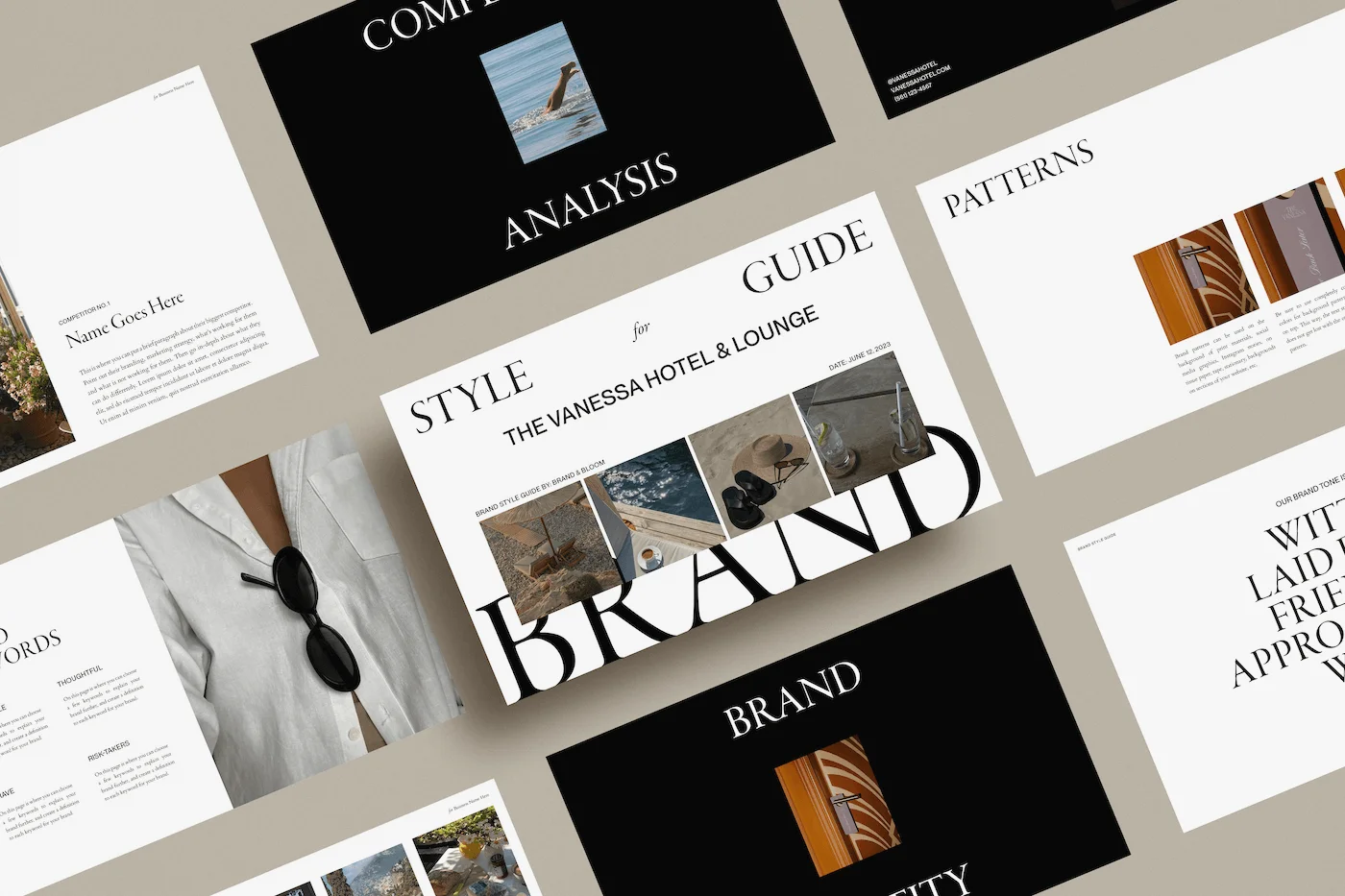
The Ultimate Brand Style Guide Template: What to Include in 2026
Most brand style guides fail because they are built as design police rulebooks.
A modern style guide is an API for your brand – a set of operational instructions built primarily for non-designers and AI agents to execute your identity without asking permission.
Treating your guidelines as a static document guarantees inconsistency the moment it leaves your desktop.
Inconsistent branding directly bleeds revenue through cognitive friction. Startups and small businesses that constantly shift their visual identity or tone of voice prevent consumers from building mental shortcuts.
The Ehrenberg-Bass Institute for Marketing Science proves that rigorous adherence to Distinctive Brand Assets – specific colors, shapes, and fonts – is what actually drives brand recall and purchasing behavior.
Without a strict, executable system, you leave your Brand identity design to chance, interpreting every new marketing campaign through a different, diluted lens.
What Are Brand Style Guides?
A brand style guide is an operational framework for reproducing a company’s identity consistently. It gives internal teams and external contractors exact visual, verbal, and technical rules for logo usage, color values, typography, messaging, and AI-generated content.
- Logo usage: clear space, minimum sizing, and restrictions that prevent misuse.
- Color system: exact HEX, RGB, CMYK, and Pantone values, plus accessibility contrast requirements.
- Typography: typefaces, weights, and semantic roles for headings and body copy.
- Voice and AI instructions: tone rules, approved and banned vocabulary, and prompt requirements for generated content.

Key Components:
- Visual identity constraints detailing strict logo, clear space and sizing limitations.
- Objective color systems utilizing exact HEX, RGB, and CMYK values alongside accessibility contrast ratios.
- Typographic hierarchies assign specific typefaces and weights to distinct semantic roles.
A brand style guide must include clear spatial rules for logos, hex codes for color palettes, semantic typography hierarchies, and specific AI prompt instructions to maintain tone of voice across generated content.
The Core DNA: Visual Asset Constraints
Visual consistency requires mathematical precision, not aesthetic opinions. Designers and marketers cannot guess how much space a logo needs or what shade of blue to use on a landing page.
Logo Systems and Spatial Rules
A brand style guide should define logo rules that preserve legibility and prevent visual crowding across digital and print use. The logo section should specify the following operational constraints:
- Clear space: define the minimum empty area around the logo, often using an element within the logo such as the height of a specific letter.
- Minimum size: set minimum requirements in pixels for digital screens and millimeters for print materials.
- Prohibited treatments: prohibit stretching, unauthorized color overlays, and drop shadows.
- Approved formats: provide the appropriate logo versions for the environment where the mark will appear.
You must dictate minimum size requirements for both digital screens (measured in pixels) and print materials (measured in millimeters) to ensure legibility.
Uber’s 2018 rebrand by Wolff Olins succeeded entirely because it imposed strict spatial constraints that allowed the logo to scale seamlessly across mobile apps and massive billboards.
Provide explicit rules on what not to do: no stretching, no unauthorized color overlays, and no drop shadows.
Objective Color Systems and Accessibility
A brand style guide color section should document exact values, intended roles, and accessibility constraints so the palette remains consistent across screens and print. Include:
- Web and screen values: HEX codes for web design and RGB values for digital screens.
- Print and physical values: CMYK percentages for standard printing and Pantone references for exact physical matching.
- Semantic color roles: primary brand colors, secondary accent colors for interactive elements, and functional colors for error or success states.
- Accessibility rules: exact WCAG 2.2 contrast ratios for text and background combinations, including dark, highly contrasted text on backgrounds such as #e3ecff.
Relying on an eyedropper tool guarantees brand degradation within a single fiscal quarter. You must map these colors to specific semantic functions: primary brand colors, secondary accent colors for interactive elements, and functional colors for error states or success messages.
Determine exact WCAG 2.2 contrast ratios for your text against background colors. A background color like #e3ecff requires dark, highly contrasted text to pass accessibility standards, preventing visually impaired users from abandoning your site.
Read more about the science behind these choices in our guide to brand color psychology.
Typographic Hierarchies and Semantic Roles
Fonts carry distinct emotional weight and require strict deployment rules. You must assign specific typefaces to explicit HTML elements rather than leaving them to the writer’s discretion.
Assigning a heavy, commanding font like Inter Extra Bold exclusively for H1 and H2 headings establishes immediate visual hierarchy. Pairing it with a highly legible, monolinear font like Inter Regular for body text prevents reading fatigue.
Provide exact specifications for line height (leading), letter spacing (tracking), and paragraph margins.
Define the exact fallback fonts for web development – such as Arial or Helvetica – so the website layout does not collapse when a user’s browser blocks custom font loading.
A style guide must eradicate subjective design decisions by providing mathematical constraints for every visual asset. Exact pixel measurements for logo clear space, specific HEX codes for accessible color contrast, and rigid semantic assignments for typography prevent brand degradation across diverse platforms and external agencies.
The Verbal Protocol: Voice, Tone, and AI Integration
Words define your market positioning as sharply as your logo. Without a codified verbal protocol, your brand sounds like a different company depending on which employee or algorithm wrote the copy.
Codifying Tone and Vocabulary
A brand voice and tone section should define the language rules that keep messaging consistent across people, channels, and customer situations. A practical verbal protocol includes:
- Core personality: the stable characteristics that define how the brand communicates.
- Situational tone: guidance for adapting the voice to moments such as onboarding or failed payment notifications.
- Vocabulary rules: approved service language, industry terms to avoid, and explicitly banned wording.
- Grammatical perspective: a decision between first-person plural, such as “We believe,” and third-person objective, such as “The company states.”
- Editorial standard: one style manual, such as the AP Stylebook, for consistent punctuation.
An onboarding email requires an encouraging tone, while a failed payment notification demands direct, empathetic clarity. You must build a specific vocabulary ledger: words you actively use to describe your services and industry jargon you explicitly ban.
A Dallas-based commercial real estate firm that uses colloquial slang in a legal briefing instantly destroys trust. Define the grammatical perspective.
Dictate whether your brand speaks in the first-person plural (“We believe”) or third-person objective (“The company states”), and enforce a single style manual, such as the AP Stylebook, for consistent punctuation.
Structuring Guidelines for Large Language Models
Yes, a 2026 brand style guide needs AI prompt rules if employees use generative tools to create brand content. Pre-written prompt templates for ChatGPT, Gemini, or Claude should define:
- Persona: the role and communication character the AI should follow.
- Target audience: the intended reader or customer segment.
- Banned vocabulary: words and phrases that do not fit the brand.
- Formatting requirements: the required structure and presentation of the output.
Specific instructions produce more usable on-brand copy than a vague request to write in a professional tone.
These prompts must define the persona, target audience, banned vocabulary, and specific formatting requirements. Simply telling an AI to “write in a professional tone” yields generic, unreadable output.
Instructing the AI with a prompt like “Act as a direct, slightly edgy B2B consultant targeting startups, use high sentence burstiness, and never use the word ‘delve'” produces immediately usable content.
Providing these guardrails in the style guide ensures that even junior team members generate content that aligns perfectly with your established brand identity strategy.
Verbal identity requires strict operational guardrails to survive multiple authors and generative algorithms. Codifying specific situational tones, banning exact vocabulary, and providing pre-engineered system prompts ensure your brand voice remains consistent whether an internal copywriter or an AI model drafts the text.
The PDF Myth
The Static Document Fallacy
The idea that a brand style guide must be a massive, beautifully typeset PDF is an operational liability.
Historically, agencies delivered 100-page PDF rulebooks because print production required immutable standards. That format is completely obsolete.
A PDF cannot update itself when your marketing team changes a primary hex code to improve mobile accessibility.
It sits on a hard drive, immediately outdated the day it is exported. Modern startups manage their operations in dynamic environments like TickTick or Notion; their brand rules must live in similar centralized, living databases.
When you rely on a static document, contractors end up referencing a version from two years ago, leading to conflicting assets across your digital footprint. You must build your guidelines as a digital hub – using tools like Frontify, a dedicated Notion wiki, or a shared Figma library.
This ensures every designer, developer, and writer pulls from a single source of truth that updates globally the moment a change is authorized.
If you want to understand the foundational elements before digitizing them, review the core logo design principles.
The static PDF brand book is a dead format that guarantees operational failure. Modern brand consistency requires dynamic, centralized digital systems that update in real-time, ensuring internal teams and external vendors always pull the exact, current specifications from a single source of truth.
The State of Brand Style Guides in 2026
The rapid integration of Generative Engine Optimization (GEO) and multimodal AI models has fundamentally altered how companies construct and deploy brand guidelines.
A style guide is no longer just for human consumption; it must parse cleanly into machine logic.
In late 2024 and throughout 2025, tools like Canva’s Dream Lab and advanced Custom GPTs shifted the burden of design and copywriting from trained professionals to generalist employees.
A marketing manager can now generate a full campaign image or write a 2,000-word article in seconds.
This speed breaks traditional brand enforcement. If your style guide exists only as visual examples, an AI image generator cannot interpret it. You must now include exact text-to-image prompt modifiers in your guidelines.
If your brand relies on a specific photographic style – such as high-contrast black and white photography with film grain – your style guide must dictate the exact phrasing required to generate that imagery consistently across different AI platforms.
Furthermore, companies are now training private, fine-tuned LLMs on their proprietary brand guidelines.
Instead of an employee reading a document to see if their copy is on-brand, they submit the copy to an internal AI agent that audits it against the brand’s exact syntactic rules. The brand style guide of 2026 functions as the raw training data for these agents.
If your guidelines lack explicit, data-driven constraints – if they rely on vague terms like “friendly” or “modern” instead of concrete rules – the AI cannot enforce them.
The Nielsen Norman Group’s UX research on cognitive load continues to prove that users abandon interfaces that feel disjointed. Your style guide is the only defense against the massive influx of inconsistent, AI-generated content flooding the market.
To see how these systems fit into a broader agency deployment, review our services.
The proliferation of generative AI requires that style guides serve as machine-readable training data. Brands must provide explicit text-to-image prompt modifiers and syntactical rules, allowing custom AI agents to enforce visual and verbal consistency automatically across all decentralized marketing outputs.
The Consultant’s Reality Check
I once audited a Dallas tech startup that had spent $40,000 on a gorgeous, 80-page brand guidelines PDF created by a traditional agency.
Six months later, their website, their social media, and their sales decks looked like they belonged to three entirely different companies.
In our work, we consistently see founders assume that buying a rulebook guarantees compliance. It does not.
The most expensive mistake I’ve watched a founder make was handing that static PDF to a junior marketing team and assuming they knew how to translate it into a Mailchimp template or an Astro web build.
The junior team couldn’t extract the CSS variables, they didn’t know how to prompt ChatGPT to match the tone of voice, and the entire brand equity fragmented in weeks.
You must stop treating your style guide as a coffee table book. You need a system. Extract the hex codes, the font files, and the tone of voice prompts and load them directly into your project management software, your website CMS, and your AI tool instructions.
Make it harder for your team to go off-brand than it is to stay on-brand.
The Core Elements: Professional Implementation
| Component | The Wrong Way (Amateur) | The Right Way (Pro) | Why It Matters |
| Color Specifications | “Our brand is baby blue and dark gray.” | Exact #e3ecff hex, RGB values, and passing WCAG 2.2 contrast ratios. | Prevents color shifts across devices and ensures legal accessibility compliance. |
| Logo Files | Supplying a single 300×300 pixel PNG file. | Providing a library of SVG vectors, reversed-out versions, and strict spatial clear zones. | Guarantees the logo remains sharp and legible whether on a phone screen or a billboard. |
| Typography Rules | “Use a clean, modern font.” | Assigning Inter Extra Bold strictly to H1/H2 and Inter Regular for body, with exact line-heights. | Establishes immediate visual hierarchy and eliminates reading fatigue. |
| Tone of Voice | “We are professional but fun.” | Codifying exact banned vocabulary, sentence burstiness rules, and specific AI prompt templates. | Ensures copy sounds identical regardless of which employee or algorithm wrote it. |
| Format and Delivery | A massive, static PDF file stored on one person’s hard drive. | A centralized, dynamic digital hub (Notion, Figma variables) accessible to the whole team. | Creates a single source of truth that updates instantly across the entire organization. |
The Verdict
Most brand style guides fail because they are built as design police rulebooks.
As we have demonstrated, a modern style guide is an API for your brand – a set of operational instructions built primarily for non-designers and AI agents to execute your identity without asking permission.
Relying on subjective aesthetic choices or a static document guarantees that your brand equity will dilute across platforms and external vendors.
You must establish mathematical constraints for your visual assets, codify your tone of voice into machine-readable prompts, and host the entire system in a dynamic, centralized digital environment.
Doing so protects your market recognition and drastically reduces the friction of creating new content. Stop wasting money on PDFs that sit in folders. Build an operational brand system that actually scales.
To audit your current assets and build a system that AI and humans can actually execute, explore our complete Brand identity design frameworks and learn exactly how to create brand guidelines that protect your equity.
FAQs
Why is a brand style guide important for a small business?
A brand style guide prevents expensive inconsistency. It provides strict visual and verbal constraints, ensuring every marketing asset looks and sounds identical. This consistency builds consumer trust, reduces the cognitive load on your audience, and speeds up internal content production.
How do I choose the right typography for my brand guidelines?
Select typography based on legibility and semantic hierarchy. Assign a distinctive, heavy font for headers to command attention and a clean, highly readable font for body text. Document specific line heights and tracking values to enforce layout consistency across all digital platforms.
What is the difference between a style guide and brand identity?
Brand identity is the overarching strategy encompassing your market positioning, values, and visual assets. A style guide is the operational instruction manual detailing exactly how to execute that identity. The identity is the theory; the style guide is the strict technical execution.
Is it true that brand style guides should be updated every year?
No, a style guide should be a living, dynamic system that updates continuously as your technical needs evolve. Storing guidelines in centralized digital hubs rather than static documents allows you to adjust color accessibility ratios or AI prompt protocols immediately without waiting for an annual review.
When should I hire an agency to build my brand guidelines?
Hire an agency when internal inconsistency starts costing you revenue or consumer trust. If your sales decks, website, and social media channels look like they belong to different companies, you require external experts to audit your assets and codify a strict operational framework.
What must be included in the color section of the guidelines?
The color section must include exact HEX, RGB, CMYK, and Pantone values for primary and secondary palettes. It must also mandate strict WCAG 2.2 accessibility contrast ratios, explicitly dictating which text colors are legally and visually safe to place over specific background colors.
How do brand guidelines work with generative AI tools?
Modern guidelines must include pre-engineered system prompts and explicitly banned vocabulary lists. Feeding these specific syntactical rules into Custom GPTs or Claude ensures the AI generates content that matches your exact corporate tone of voice, rather than generic text.
Why are spatial clear zones necessary for a logo?
Clear zones prevent visual crowding and maintain brand authority. By mathematically defining the minimum empty space required around a logo – often based on a specific letter’s height within the design – you ensure external vendors and partners never compromise the logo’s legibility on their platforms.
What happens if I don’t establish a tone-of-voice document?
Without a tone-of-voice document, your brand sounds schizophrenic. Customers receive an aggressive sales email, a passive-aggressive customer support response, and a jovial social media post. This lack of verbal consistency destroys trust and makes your company appear unprofessional and disorganized.
How do I enforce my brand guidelines across a remote team?
Enforce guidelines by integrating them directly into your workflow software. Host the rules in a central Notion wiki, supply pre-approved templates in Canva or Figma, and hardcode your color hexes into your website CSS. Make staying on-brand the path of least resistance.